The Beauty of the Head
Flows in One Continuous Contour.
The beauty of the head is not defined by the height of any single area.
A natural, balanced head contour comes from the harmony of curves, transitions, and overall proportions from the forehead through the vertex to the occiput.
Forehead · Vertex · Occiput
Head contouring can be divided into forehead augmentation, vertex augmentation, and occiput augmentation, depending on the area and contour that need improvement.
Each area has its own characteristics, but surgical planning considers not only the area being treated, but also how naturally it transitions into the surrounding contours of the head.
Height and curvature of the forehead and its transition into the upper head contour

Height and volume of the vertex and its transition between the front and back of the head

Projection and curvature of the occiput as seen from the side and back

The Changes Needed
Are Different for Everyone.
Head shape and proportions, the degree of asymmetry, and scalp characteristics vary from person to person.
Rather than applying a predetermined shape, we evaluate the existing head contour and determine where change is needed and how much change is appropriate for each individual.
Creating a Natural
Forehead Contour.
Forehead augmentation adds volume where needed to a flat or backward-sloping forehead, creating a more natural and balanced contour.
Rather than simply increasing forward projection, we consider the overall curve from the brow ridge across the forehead and into the upper head contour.
More Than Height,
It Is About Shape and Proportion.
A natural forehead contour is not determined by projection alone.
We consider the slope and curvature of the forehead, the shape of the central and lateral areas, facial proportions, and the transition into the upper head contour.
Designing the Changes
Based on Your Existing Contour.
Forehead slope and width, asymmetry, and the prominence of the brow ridge vary from person to person.
Before surgery, we evaluate the forehead, overall head contour, and facial proportions to determine the appropriate areas and extent of augmentation for each individual.
Adding Natural Height and Volume
to a Low, Flat Vertex.
The vertex lies between the forehead and occiput and plays an important role in defining the height and upper contour of the head.
Vertex augmentation adds volume where needed to a low or flat upper head, creating a contour that flows naturally from front to back.
Not Just a Single High Point,
but a Natural Transition.
A natural vertex contour depends not only on the position and height of its highest point, but also on the curves surrounding it.
We consider the overall contour so that the curve rising from the forehead into the vertex and the curve continuing from the vertex toward the occiput transition smoothly.
The Location and Extent
Are Individually Determined.
Vertex height and shape, its relationship to the front and back of the head, and scalp characteristics vary from person to person.
We evaluate the existing head contour to determine where volume is needed and how much augmentation is appropriate, while maintaining a natural balance with the overall head shape.
Adding a Natural Curve
to a Flat Occiput.
Occiput augmentation adds volume where needed to a flat, underprojected, or volume-deficient occiput, creating a more natural head contour from both the side and back.
Rather than simply increasing backward projection, we consider the curve from the vertex into the occiput and the overall proportions of the head.
More Than Projection,
It Is About a Natural Curve.
A natural occipital contour is not defined by a single point of maximum projection.
We consider the curve from the vertex into the occiput, the location of volume, and the transition into the lower head contour to design a natural occipital shape.
Flatness and Asymmetry
Are Considered Together.
Occipital shape varies from person to person, including the location and extent of flatness and the degree of left-right asymmetry.
We evaluate the existing occiput and its proportions relative to the surrounding head contour to determine the appropriate areas and extent of augmentation for each individual.
PMMA Has Been Used
in Medicine for Decades.
PMMA (polymethyl methacrylate) is an acrylic polymer that has been used in the form of bone cement in various medical fields, including orthopedics and cranial reconstruction.
When its powder and liquid components are mixed, the material gradually hardens. Before hardening, it can be shaped into the desired contour.
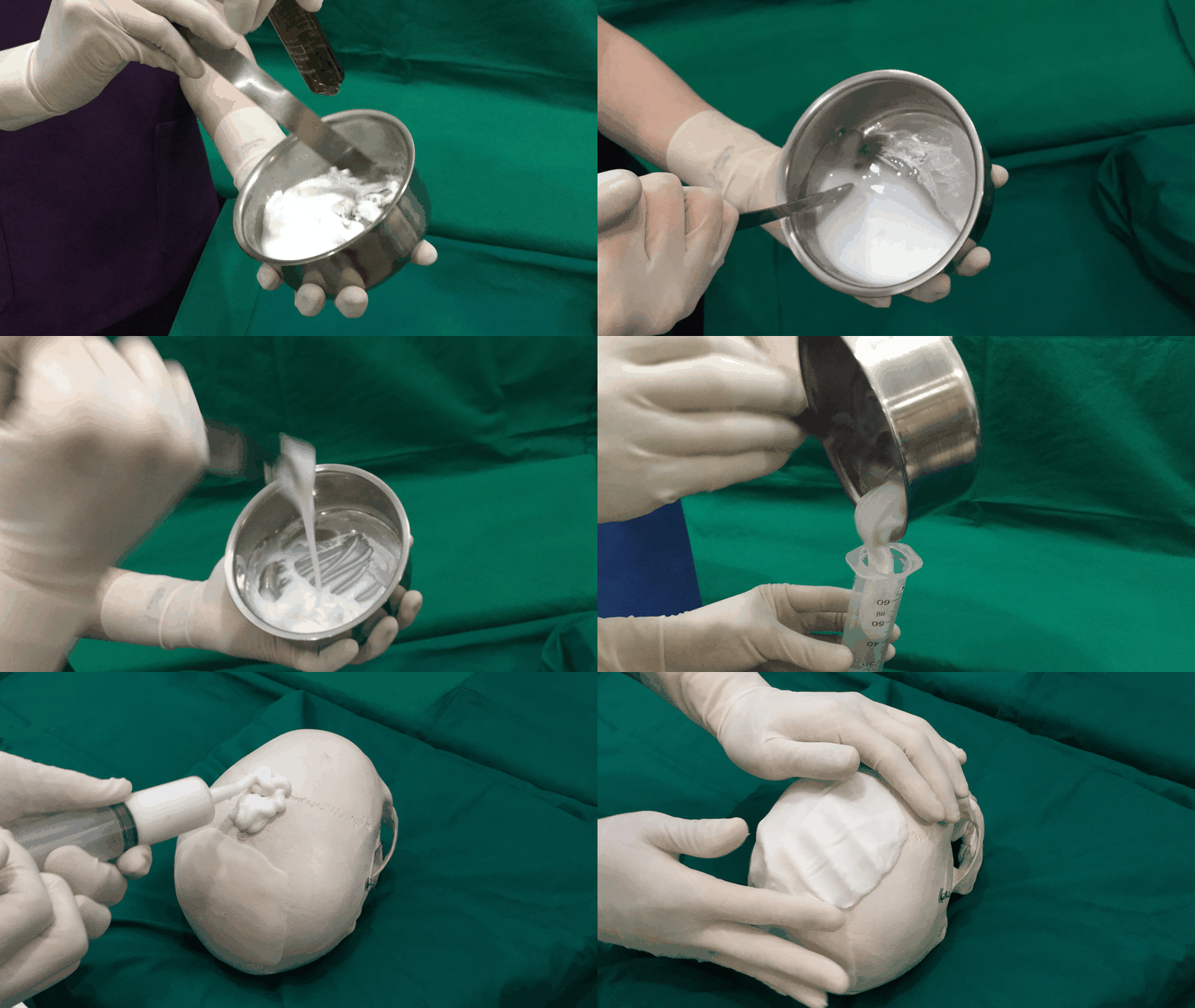

Shaped During Surgery,
Rather Than Using a Predetermined Shape.
Every head differs in size and shape, as well as in the location and extent of volume needed.
Because PMMA can be shaped before it hardens, it allows the surgeon to contour the material directly during surgery according to the required location and extent, while assessing the existing head and surrounding contours.
At JOGAK Plastic Surgery, this characteristic is used to create an individualized contour for each head rather than applying a single predetermined shape.

A Non-Absorbable Material
That Maintains Its Contour.
PMMA is a non-absorbable material and does not naturally dissolve or disappear within the body.
Once hardened, it maintains the contour created during surgery and can therefore be used to augment the contour of the skull.
Because of this characteristic, careful planning of the location and extent of augmentation and precise intraoperative contouring are important.

Understanding Both the Characteristics
and Limitations of the Material.
No surgical material is entirely free from the possibility of complications.
Potential complications associated with PMMA include infection, hematoma, wound-healing problems, and issues related to the position or contour of the material. In some cases, additional correction or removal may be necessary.
PMMA also generates heat during the polymerization process as it hardens after mixing. Understanding the properties of the material and handling it appropriately are therefore important.
Material Choice Matters.
So Do Experience and Judgment.
Head contouring involves more than simply choosing PMMA as the material.
It is important to evaluate the existing head contour and scalp condition and determine where volume should be added, how much is appropriate, and how the augmented area should transition naturally into the surrounding head contour.
JOGAK Plastic Surgery has accumulated extensive clinical experience in aesthetic head contouring using PMMA, with clinical outcomes of forehead and occiput augmentation published in an international peer-reviewed journal.
A Limited Scalp Incision,
with Direct Intraoperative Contouring.
Head contouring is performed through a scalp incision selected according to the area and contour planned before surgery.
After PMMA bone cement is applied, the material is directly contoured during surgery according to the planned shape, while assessing the existing head and surrounding contours.
The existing head shape and proportions are evaluated to determine the location and extent of the desired change.
The surgical area is accessed through a planned scalp incision.
PMMA bone cement is applied to the planned area and directly shaped to create a natural transition with the surrounding head contour.
After the final contour and left-right balance are assessed, the scalp incision is closed.
After Surgery
After surgery, a compression head bandage is applied to help control bleeding and swelling and to protect the surgical area.
Compression bandage removal
Shampooing permitted
Staple removal
For more information on preparation before surgery and postoperative care, please see the
PATIENT GUIDE.
